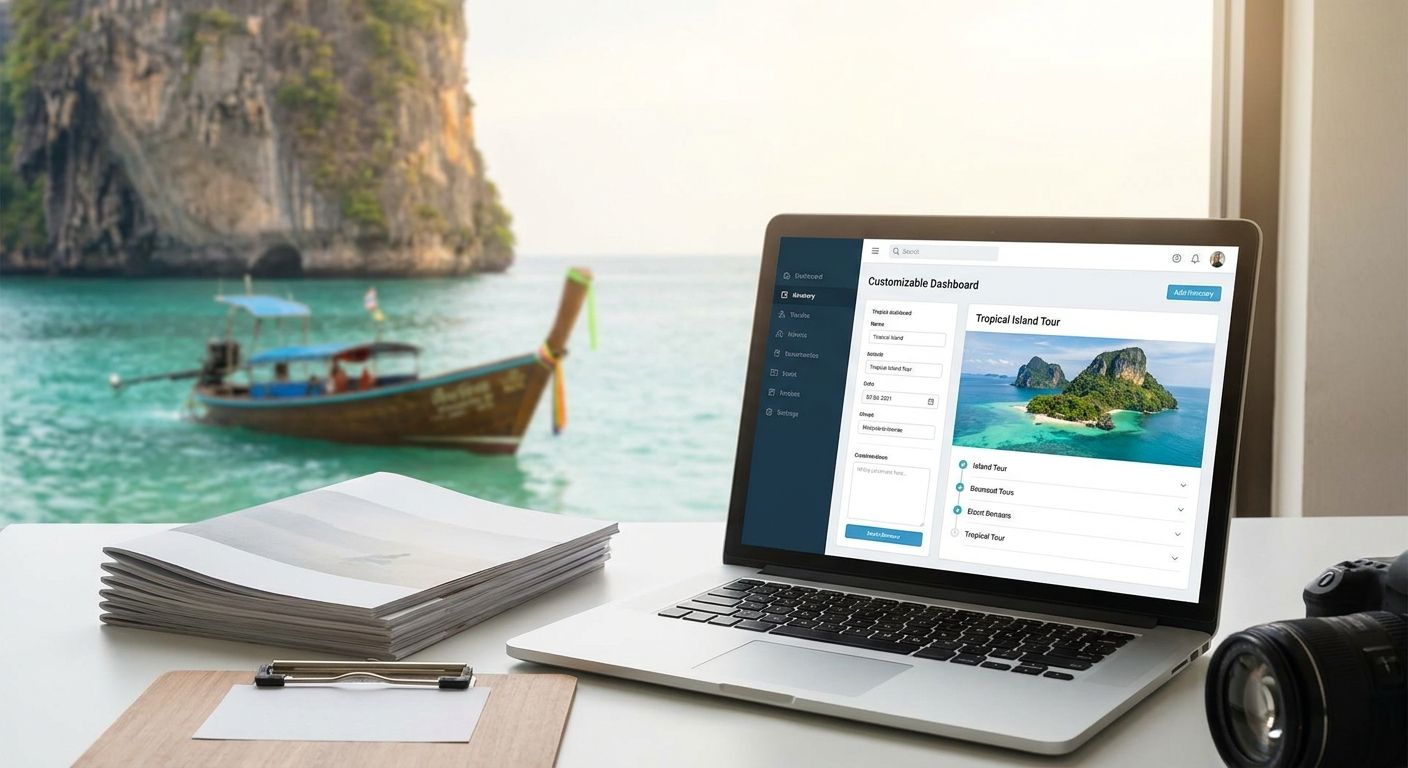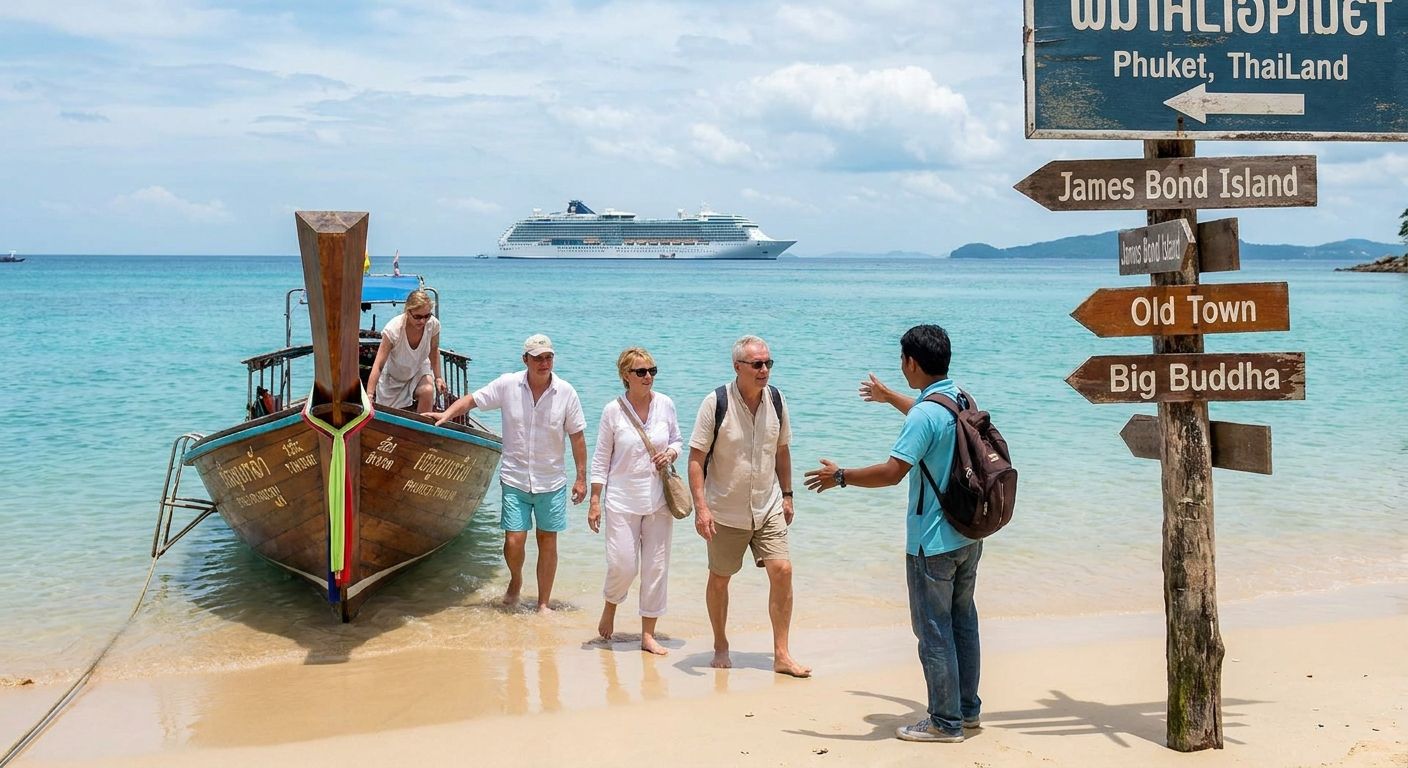
Cruise lines give you a fixed port call window and zero patience for late buses — build the wrong itinerary and 40 passengers miss their tender back to the ship. This guide walks a Phuket-based DMC or travel agent through assembling a shore excursion itinerary that survives real port-day math, from transfer timing to backup weather plans.
- A Phuket shore excursion itinerary for cruise groups starts with the port call window, not the tour brochure — build backward from ship departure time.
- James Bond Island tours for cruise ship excursion agents fit a 6-9 hour call better than Phi Phi full-day trips, which often run 7-8 hours alone.
- SIC (seat-in-coach) transfers cut cost per head but add pickup stops; private transfer wins when the window is under 7 hours.
- Build a 60-90 minute buffer before final boarding call in 2026 — port traffic and tender delays are the top cause of missed reboarding.
- Always confirm a monsoon-season backup route before quoting the itinerary to the cruise operator.
Why this matters
A missed reboarding isn't a refund problem — it's a relationship problem. Cruise operators that get burned by a late group stop sending you allotment for the season, and in 2026 Phuket's Deep Sea Port and Patong tender points are both handling more calls than they did two years ago, which means tighter turnaround windows and less tolerance for a DMC that runs its buses on guesswork.
An itinerary built for a resort guest with a full day to spare does not transfer to a cruise passenger with a hard 6-9 hour window. The excursion has to be picked, timed, and buffered specifically for the ship's schedule — not adapted from a land-tour package after the fact.
What you'll need
- The ship's confirmed port call window (arrival and final boarding time, not just "in port")
- A shortlist of excursions that fit inside that window with transfer time included
- Transfer capacity confirmed — private vehicle or SIC coach, sized to group count
- A per-passenger price built for resale, not retail rate
- A backup plan for monsoon-season closures (typically May through October in the Andaman)
- A single onboard or dockside contact who can call an audible if the tender runs late
The steps
1. Pull the port call window first, before touching a brochure
Start every itinerary with two numbers: dock time and last boarding call. Everything else in this list gets built backward from the last boarding call, not forward from a wish list of attractions.
Common mistake: agents quote the excursion off the ship's advertised "in port" hours instead of confirming the operator's actual final boarding cutoff, which is usually 30-45 minutes earlier than the ship's official departure.
2. Match excursion length to the window, not the other way around
A 6-9 hour port call rules out a full Phi Phi Island day trip in most cases — those routes commonly run 7-8 hours door to door once you count the boat transfer, and there's no slack left for traffic. For a tighter window, James Bond Island tours for cruise ship excursion agents pack sightseeing, canoeing, and a lunch stop into a half-day format that leaves reboarding buffer intact.
For longer calls (9+ hours), a full-day Phi Phi Island tour package or a Krabi day trip can work, but only if the pier used for that route is close to the cruise dock — check this before quoting, not after.
Common mistake: picking the itinerary the passenger will enjoy most instead of the one that fits the clock. Enjoyment doesn't matter if the group misses the ship.
3. Decide private transfer vs. SIC before you price anything
This single decision changes your margin and your risk profile more than any other line item. SIC (seat-in-coach) transfers cost less per head because the vehicle serves multiple hotels or pickup points, but each stop eats into your buffer.
Private transfer costs more per passenger but removes the stop-and-wait variable entirely — for cruise groups with a hard deadline, that trade is usually worth it. Walk through the trade-offs in detail in how to choose SIC vs. private transfer for James Bond Island tours before locking the itinerary.
Common mistake: defaulting to SIC because it's cheaper, then discovering the coach has three more hotel stops than the quote assumed.
4. Confirm airport and pier transfer logistics for group size
Cruise groups move in blocks of 20, 40, sometimes over 100 passengers at once — a single van booking will not cover that, and last-minute vehicle scrambles are how DMCs blow their margin. Lock transfer capacity against the confirmed headcount before the itinerary goes to the cruise line for sign-off.
For group volumes above one bus, review how to book Phuket airport transfers for large tour groups — the same fleet-sizing logic applies to pier-to-excursion transfers, not just airport runs.
Common mistake: booking transfer capacity for the passenger count on the manifest instead of the count that actually shows up dockside, which typically runs 5-10% under manifest on any given call.
5. Build in a 60-90 minute reboarding buffer
Every itinerary segment — transfer, activity, lunch, transfer back — should have padding built in, and the total padding across the day should land at 60-90 minutes before the final boarding call. This is the single line item that protects your relationship with the cruise operator more than any other.
Common mistake: building the buffer into the middle of the day (extra time at the beach) instead of the end (extra time before the pier). Passengers wander off during "extra" beach time; they don't wander off from a bus that's already moving toward the ship.
6. Price the package for resale, not retail
A cruise shore excursion itinerary quoted at retail rates gets undercut by the next DMC in the operator's inbox. Wholesale rate structures need to hold margin at volume — this is where a functioning agent-rate sheet matters more than a pretty brochure.
Common mistake: pricing per-person the same way for a 20-pax group and a 100-pax group. Vehicle and guide costs don't scale linearly, and neither should your rate.
Get wholesale cruise excursion rates
Agent pricing for Phuket and Krabi shore excursion packages, sized for cruise group volume.
7. Lock a monsoon-season backup route
May through October brings rough seas across the Andaman, and boat-based excursions get cancelled with little notice on the worst days. Every itinerary quoted for cruise groups in 2026 needs a land-based or sheltered-water backup that can slot in within an hour of a cancellation call.
Common mistake: no backup at all, which forces a same-day refund conversation with the cruise operator instead of a same-day swap.
Troubleshooting
- Tender running 30+ minutes late: cut the itinerary's lowest-priority stop (usually the souvenir or lunch buffer stop), not the return transfer buffer.
- Group splits between fast and slow walkers: assign a second guide at the activity site rather than slowing the whole group to the slowest pace — this protects the reboarding buffer.
- Boat operator cancels for sea conditions: activate the pre-agreed land-based backup immediately; don't wait for a replacement boat slot that may not exist that day.
- Passenger count on the day differs from manifest: confirm actual headcount at pickup, not at booking — vehicles sized for the manifest number, not the day-of number, run empty or overflow.
- SIC pickup runs long: renegotiate pickup order with the coach operator before the season starts, not mid-itinerary.
- Seasickness on boat-based excursions: keep a land-based alternative (Krabi Hong Island or a canoe-based Phang Nga route with calmer water) ready as a same-morning swap.
Tools and resources
- Krabi 4 Island tours for travel agents — an alternative full-day option when the port call window runs long
- Best Krabi day tour packages for travel agents to resell — comparison of Krabi-based itineraries for resale margin
- Confirmed port call schedule from the cruise line's shore excursion desk
- A per-passenger rate sheet built for wholesale, not retail, pricing
- A named dockside contact with authority to swap the itinerary same-day
What to do next
Once the itinerary structure is locked, the next decision is which specific route earns the group's day — that comparison work is covered in the Krabi day tour resale guide linked above, which breaks down margin and timing side by side.
FAQ
What's the best Phuket shore excursion for a 6-hour cruise port call?
A half-day James Bond Island tour fits a 6-hour window better than a full-day route, since it leaves transfer and buffer time intact. Full-day trips like Phi Phi Island commonly run 7-8 hours and don't leave enough margin for a short call.
Is private transfer better than SIC for cruise excursion groups?
Private transfer removes multi-stop delay risk and suits hard-deadline cruise groups better than SIC. SIC costs less per head but adds pickup stops that eat into the reboarding buffer.
How much buffer time should a cruise shore excursion itinerary include?
Build 60-90 minutes of buffer before the ship's final boarding call, not spread through the middle of the day. That buffer is what protects the group from tender delays and traffic on the return leg.
What happens if a boat tour gets cancelled for sea conditions during a cruise call?
A pre-agreed land-based backup route needs to activate within about an hour of the cancellation call. Monsoon season (May-October) makes boat cancellations more common, so backups should be locked before the season starts, not improvised on the day.
How many passengers can one shore excursion itinerary handle?
Group size is limited by vehicle and boat capacity, not by the itinerary itself — large groups need transfer capacity confirmed against actual headcount, not manifest count. Cruise groups often move in blocks of 20 to 100+ passengers across multiple vehicles.
Should shore excursion pricing be quoted at retail or wholesale rates?
Wholesale rate sheets built for resale protect margin at cruise group volume, where retail pricing gets undercut by competing DMCs. Pricing should also scale by group size rather than staying flat per person.
What's the biggest risk in a Phuket shore excursion itinerary for cruise groups?
Missing the ship's final boarding call is the biggest risk, and it usually comes from an itinerary built without a reboarding buffer. A missed reboarding damages the relationship with the cruise operator more than any single refund.
Does Phuket weather affect cruise shore excursion planning?
Yes — the Andaman monsoon season runs roughly May through October and causes boat-based excursion cancellations on rough-sea days. A land-based backup route needs to be locked in before quoting the itinerary for that period.
One last thing
The itinerary that looks best on paper — full-day, scenic, high margin — is often the one most likely to blow the reboarding window. The itineraries that keep cruise operators coming back in 2026 are the boring, buffered ones that get the group back to the pier with time to spare, every single call.